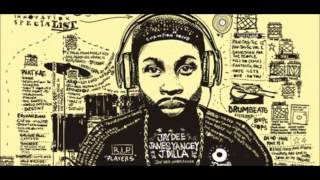
J Dilla
The most influential beatmaker of his generation. Dilla's deliberately off-kilter drum programming and deep soul samples redefined what hip-hop could feel like — loose, human, and impossibly deep.
Now playing
J Dilla
About
James Dewitt Yancey — J Dilla — came out of Detroit's Conant Gardens neighborhood in the early '90s with ears trained on his mother's jazz and soul record collection and a hunger to flip what he heard into something new. He started programming beats on a Roland SP-1200 in his basement while still in high school, and by the time he linked with Q-Tip and connected with MCA Records as part of Slum Village, it was clear he was operating on a different level entirely. What made Dilla untouchable was his relationship with time. Where most beatmakers quantized their drums to a rigid grid, Dilla pushed and pulled his kicks and snares — sometimes off the beat, sometimes dragging behind it — creating what producers started calling "drunk" swing: that feeling that the drums are alive, slightly human, slightly wrong in all the right ways. He'd layer this against deep soul samples — George Clinton, Minnie Riperton, Bobby Caldwell — pitched down and chopped in ways that felt more like impressionism than sampling. His peak is generally understood as the stretch between Fantastic Vol. 2 (2000) and Donuts (2006), the album he finished in a hospital bed while dying from a rare blood disease. Donuts dropped on his 32nd birthday, three days before he passed. Every bar anyone writes over a Dilla beat is a conversation with that legacy — with music that refused to be neat.
Signature Sound
Drums deliberately placed off the quantized grid — kicks drag slightly behind the beat, snares breathe with a loose, human pulse that can't be replicated by a machine on auto-correct.
Sample sources run deep into '70s soul, '60s jazz, psychedelic funk, and gospel; he favored records by Bobby Caldwell, Minnie Riperton, Rotary Connection, and deep Motown B-sides that most producers never touched.
Primary weapons were an Akai MPC3000 and the Roland SP-1200, later the MPC2000XL; the MPC's internal processing gave his samples a warm, compressed color that software could not cleanly replicate.
Low end sits fat but loose — bass lines often derived from pitched-down samples rather than hard sub-bass synthesis, giving his records a rounded, vinyl-adjacent warmth rather than a club-ready thump.
Writing Over These Beats
Dilla beats have a lot of internal motion, so you don't need to fill every bar — the production breathes and so should your delivery. The best rappers over his work (Common, Guilty Simpson, Black Thought) tend to ride on top of the beat rather than inside it, letting the swing carry them rather than fighting it. Flow patterns that land somewhere between double-time and conversational work best. Dense multisyllabic rhyme schemes can fight the looseness; lean into natural pauses and let the snare breathe. Think of it as jazz phrasing — you can sit behind the beat intentionally and it sounds deliberate.
Career Arc
1996–1998: The Slum Village Years
Basement tapes, loop-heavy soul constructions, and the birth of his drum philosophy. Fantastic Vol. 1 circulated on cassette and became a cult object before most people knew his name.
1999–2002: The Commercial Peak
Production credits pile up across Common, Busta Rhymes, Erykah Badu, and Janet Jackson — beats that hit radio without losing their inner warmth, a balance almost nobody else has achieved.
2003–2005: Ruff Draft and the Turn Inward
Diagnosed with lupus and TTP, Dilla retreated from the mainstream and started making music that was stranger, darker, and more personal — Ruff Draft sounds like a man working through something.
2006: Donuts
Assembled in a hospital bed using a laptop and a portable MPC, Donuts is thirty-one tracks in forty-four minutes — a final statement that sounds less like a last album and more like a transmission.
Essential Tracks
01
Donuts (Intro) / Workinonit
The opening statement of his final album — a loop that sounds like a memory dissolving, proof that Dilla could make a two-bar sample feel like a film.
02
Fall in Love (Slum Village)
↗Minnie Riperton's 'Inside My Love' made into a head-nodding, aching instrumental that showed how far a single sample could travel in the right hands.
03
Light It Up (feat. Dwele)
From Ruff Draft, this is Dilla's low-end at its most hypnotic — a late-night Detroit record that sounds half-finished and completely perfect.
04
The Shining (Busta Rhymes)
↗Proof his beats could hit hard without losing their warmth — Busta rode the lopsided groove in a way that showed how the swing actually invited aggressive delivery.
05
Players
One of the clearest examples of his MPC chopping at peak fluency — a beat that swings so hard it almost tips over, then catches itself.
06
Two Can Win (feat. Guilty Simpson)
↗The beat breathes differently than anything else in the catalog — room to move, space to think, the instrumental equivalent of an exhale.
07
Stakes Is High (De La Soul)
His mainstream breakout production credit in 1996, showing his ability to make a politically urgent record still feel like the warmest thing you'd heard all year.
Key Collaborators
SV
Slum Village
↗
His creative home base — T3 and Baatin gave him a proving ground for his most experimental impulses across Fantastic Vol. 1 and Vol. 2, records that are still being discovered.
C
Common
↗
Their partnership peaked on Like Water for Chocolate (2000), where Dilla's dreamy, elastic production gave Common's introspective bars their most perfect sonic home.
EB
Erykah Badu
↗
Dilla produced key tracks on Mama's Gun and their creative chemistry ran deeper than the studio — she was with him in his final days and helped carry his legacy forward.
D
D'Angelo
↗
The kinship was mutual — both men were obsessed with making music feel alive and imperfect, and their orbit helped define the neo-soul moment.
MD
MF DOOM
↗
Their collaborative sessions brought together hip-hop's two great abstractionists — DOOM's labyrinthine rhymes over Dilla's sideways swing felt inevitable.
BR
Busta Rhymes
↗
Produced much of The Coming era material and later 'The Shining' — an unlikely pairing that proved Dilla's loose, warm drums could support even the most kinetic rap delivery.
Influences
Dilla absorbed everything his mother played — George Clinton's Funkadelic, the orchestral swing of David Axelrod, the modal jazz of John Coltrane — and ran it through the filter of Detroit's specific brand of melancholy. Q-Tip of A Tribe Called Quest was a direct early mentor, exposing Dilla to the jazz-rap vocabulary and connecting him to the New York underground. DJ Premier showed what drum programming as a compositional act could sound like. In turn, Dilla rewired an entire generation: Kanye West has cited him repeatedly as the reason he started making beats; Karriem Riggins, Robert Glasper, Flying Lotus, and Kendrick Lamar's entire catalog of producers trace a direct line back to the way Dilla treated the grid as a suggestion rather than a law.
Sample DNA
Dilla dug primarily from American soul, R&B, and funk records of the late '60s and '70s — Motown, Stax, the CTI jazz label, and the deep psychedelic soul underground around Rotary Connection and Minnie Riperton. He also pulled from Brazilian tropicália, British jazz-funk, and obscure gospel 45s. Geographically it was Detroit, Chicago, and New York, with occasional excursions into Afrobeat and bossa nova. He favored records that were emotionally open — love songs, quiet storms, jazz ballads — and transformed them into something entirely his own through pitch manipulation and rhythmic displacement.
Gear & Tools
The Akai MPC3000 is the center of the Dilla mythology — its internal sixteen-bit AD/DA converters added a specific compression and warmth that software samplers don't replicate cleanly. He later moved to the MPC2000XL. The Roland SP-1200 was his earliest machine and gave Fantastic Vol. 1 its gritty, lo-fi crunch. In the hospital, he worked on a PowerBook G4 with Reason — Donuts was partly a product of limitation forcing invention.